Vulnerability Report: SMTP Header Injection via Regex Bypass
Vulnerable Code: mailpit/internal/smtpd/smtpd.go
Executive Summary
Mailpit's SMTP server is vulnerable to Header Injection due to an insufficient Regular Expression used to validate RCPT TO and MAIL FROM addresses. An attacker can inject arbitrary SMTP headers (or corrupt existing ones) by including carriage return characters (\r) in the email address. This header injection occurs because the regex intended to filter control characters fails to exclude \r and \n when used inside a character class.
RFC Compliance & Design Analysis
"Is this behavior intentional for a testing tool?"
No. While testing tools are often permissive, this specific behavior violates the core SMTP protocol and fails the developer's own intent.
- RFC 5321 Violation: The SMTP protocol strictly forbids Control Characters (CR, LF, Null) in the envelope address (
Mailbox).
- RFC 5321 Section 4.1.2: A
Mailbox consists of an Atom or Quoted-string. An Atom explicitly excludes "specials, SPACE and CTLs" (Control Characters).
- Failed Intent: The existence of
\v in the regex [^<>\v] proves the developer intended to block vertical whitespace. The vulnerability is that \v in Go regex (re2) inside brackets [] matches only Vertical Tab, not CR/LF. If the design were to allow everything, the \v exclusion wouldn't exist.
- Data Corruption: Allowing
\r results in the generation of malformed .eml files where the Received header is broken. This is not a feature; it's a bug that creates invalid email files.
- RFC 5321 also enforces address lengths which are not applied in Mailpit.
Technical Analysis
The Flaw
The vulnerability exists in the regex definitions used to parse SMTP commands:
// internal/smtpd/smtpd.go:32-33
rcptToRE   = regexp.MustCompile(`(?i)TO: ?<([^<>\v]+)>( |$)(.*)?`)
mailFromRE = regexp.MustCompile(`(?i)FROM: ?<(|[^<>\v]+)>( |$)(.*)?`)
The developer likely intended [^<>\v] to mean "Match anything that is NOT a < OR > OR Vertical Whitespace".
However, in Go's regexp (RE2) syntax, the behavior of \v changes depending on context:
- Outside brackets:
\v matches all vertical whitespace: [\n\v\f\r\x85\u2028\u2029].
- Inside brackets (
[...]): \v matches only the Vertical Tab character (\x0B).
Result: The regex [^<>\v] allows Carriage Return (\r) and Line Feed (\n) characters to pass through, as they are not < or > or \x0B.
Exploit Scenario
Exploit Scenario
When Mailpit constructs the Received header, it uses the validated recipient address directly:
// internal/smtpd/smtpd.go:865
buffer.WriteString(fmt.Sprintf("        for <%s>; %s\r\n", to[0], now))
If to[0] contains victim\rINJECTED-HEADER: YES, the resulting string in memory becomes:
for <victim\rINJECTED-HEADER: YES>; ...
While bufio.ReadString prevents injecting immediate \n (newlines), \r (Carriage Return) bypasses this check.
The Result: The stored EML file contains a "Bare CR".
- RFC Violation: RFC 5321 strictly forbids Bare CR. Lines must end in CRLF.
- UI Behavior: Browsers typically render Bare CR as a space, so it may look like
victim INJECTED in the Mailpit UI.
- Real Impact: The raw email is corrupted. If this email is exported or relayed, downstream systems (Outlook, older MTAs) may interpret the Bare CR as a line break, triggering a full Header Injection. Furthermore, Mailpit failing to reject this gives developers a false sense of security, as their code might be generating malformed emails that work in Mailpit but fail in production (e.g., with Gmail or Exchange).
Raw EML Verification
The following screenshot of the raw .eml file confirms that the \r character successfully broke the Received header structure in the stored file, effectively creating a new line for the injected content.

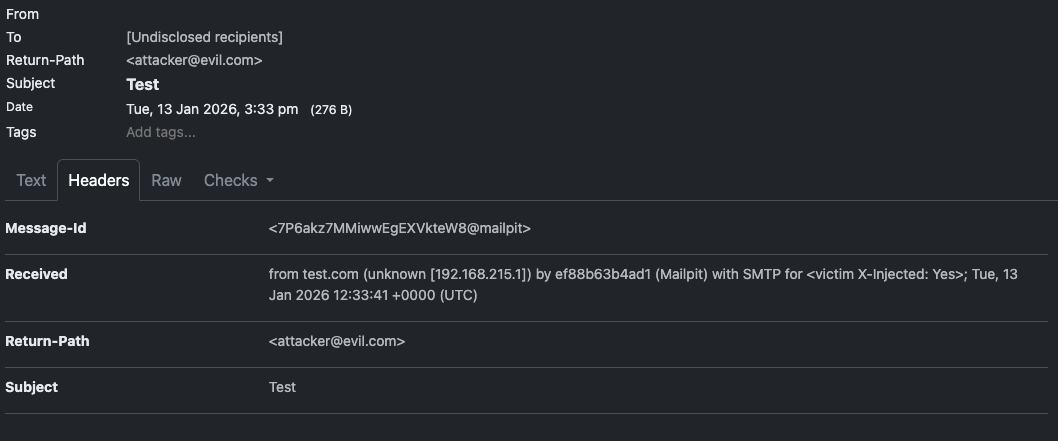

As seen in lines of the screenshot:
        for <victim
INJECTED_VIA_CR:YES>; Tue, 13 Jan ...
The INJECTED_VIA_CR:YES payload is treated as a start of a new line by the text editor (VS Code), which honors \r as a line break. This proves the injection matches the "Bare CR" attack vector.
Additional Proof of Concepts
1. Null Byte Injection (\x00)
The regex [^<>\v]+ also allows the Null Byte (\x00).
Test: test_null_byte.py sent RCPT TO:<victim\x00-NULL-BYTE-HERE>.
Result: Server accepted the message (250 OK).
Impact: The API returns an empty [] for the To field in the message summary, indicating the parser failure in the UI/API layer. The raw message content confirms the Null Byte is stored in the database.
3. Detailed Character Compatibility
Tests (0-127 ASCII) confirm that the regex [^<>\v] blocks only the following:
< (Less Than)> (Greater Than)\x0B (Vertical Tab)
Crucially, it ALLOWS:
| Character |
Hex |
Regex Status |
Network Status |
Impact |
| Carriage Return |
\r (0x0D) |
ALLOWED |
Passed |
Header Injection |
| Line Feed |
\n (0x0A) |
ALLOWED |
Blocked* |
*Blocked by bufio.ReadString, not regex. |
| Null Byte |
\x00 (0x00) |
ALLOWED |
Passed |
API DoS / Corrupt Data |
| Tab |
\t (0x09) |
ALLOWED |
Passed |
Formatting issues |
| Delete |
\x7F (0x7F) |
ALLOWED |
Passed |
Potential obfuscation |
| Controls |
0x01-0x1F |
ALLOWED |
Passed |
(Except 0x0A, 0x0B, 0x0D) |
This confirms that the regex fails to implement a proper "Safe Text" allowlist, defaulting instead to a flawed denylist.
Proof of Concept
The following Python script demonstrates the injection of a "bare CR" into the headers, which is successfully accepted by the server.
import socket

def exploit():
    s = socket.socket(socket.AF_INET, socket.SOCK_STREAM)
    s.connect(("127.0.0.1", 1025))
    s.recv(1024)
    s.send(b"EHLO test.com\r\n")
    s.recv(1024)
    s.send(b"MAIL FROM:<attacker@evil.com>\r\n")
    s.recv(1024)

    # Injecting \r
    payload = b"RCPT TO:<victim\rX-Injected: Yes>\r\n"
    s.send(payload)
    resp = s.recv(1024)
    print(f"Server Response: {resp.decode()}") # Expect 250 OK

    s.send(b"DATA\r\n")
    s.recv(1024)
    s.send(b"Subject: Test\r\n\r\nBody\r\n.\r\n")
    s.recv(1024)
    s.close()

exploit()
Remediation
Update the regex to explicitly exclude \r and \n, or use the correct character class escape for control characters.
Recommended Fix:
Use \x00-\x1F to exclude all ASCII control characters.
// Fix: Exclude all control characters explicitly
rcptToRE   = regexp.MustCompile(`(?i)TO: ?<([^<>\x00-\x1f]+)>( |$)(.*)?`)
mailFromRE = regexp.MustCompile(`(?i)FROM: ?<(|[^<>\x00-\x1f]+)>( |$)(.*)?`)
Alternatively, strictly exclude CR and LF:
rcptToRE = regexp.MustCompile(`(?i)TO: ?<([^<>\r\n]+)>( |$)(.*)?`)
Classification & References
References

omarkurt Reporter
Vulnerability Report: SMTP Header Injection via Regex Bypass
Vulnerable Code:
mailpit/internal/smtpd/smtpd.goExecutive Summary
Mailpit's SMTP server is vulnerable to Header Injection due to an insufficient Regular Expression used to validate
RCPT TOandMAIL FROMaddresses. An attacker can inject arbitrary SMTP headers (or corrupt existing ones) by including carriage return characters (\r) in the email address. This header injection occurs because the regex intended to filter control characters fails to exclude\rand\nwhen used inside a character class.RFC Compliance & Design Analysis
"Is this behavior intentional for a testing tool?"
No. While testing tools are often permissive, this specific behavior violates the core SMTP protocol and fails the developer's own intent.
Mailbox).Mailboxconsists of anAtomorQuoted-string. AnAtomexplicitly excludes "specials, SPACE and CTLs" (Control Characters).\vin the regex[^<>\v]proves the developer intended to block vertical whitespace. The vulnerability is that\vin Go regex (re2) inside brackets[]matches only Vertical Tab, not CR/LF. If the design were to allow everything, the\vexclusion wouldn't exist.\rresults in the generation of malformed.emlfiles where theReceivedheader is broken. This is not a feature; it's a bug that creates invalid email files.Technical Analysis
The Flaw
The vulnerability exists in the regex definitions used to parse SMTP commands:
The developer likely intended
[^<>\v]to mean "Match anything that is NOT a<OR>ORVertical Whitespace".However, in Go's
regexp(RE2) syntax, the behavior of\vchanges depending on context:\vmatches all vertical whitespace:[\n\v\f\r\x85\u2028\u2029].[...]):\vmatches only the Vertical Tab character (\x0B).Result: The regex
[^<>\v]allows Carriage Return (\r) and Line Feed (\n) characters to pass through, as they are not<or>or\x0B.Exploit Scenario
Exploit Scenario
When Mailpit constructs the
Receivedheader, it uses the validated recipient address directly:If
to[0]containsvictim\rINJECTED-HEADER: YES, the resulting string in memory becomes:While
bufio.ReadStringprevents injecting immediate\n(newlines),\r(Carriage Return) bypasses this check.The Result: The stored EML file contains a "Bare CR".
victim INJECTEDin the Mailpit UI.Raw EML Verification
The following screenshot of the raw
.emlfile confirms that the\rcharacter successfully broke theReceivedheader structure in the stored file, effectively creating a new line for the injected content.As seen in lines of the screenshot:
The
INJECTED_VIA_CR:YESpayload is treated as a start of a new line by the text editor (VS Code), which honors\ras a line break. This proves the injection matches the "Bare CR" attack vector.Additional Proof of Concepts
1. Null Byte Injection (
\x00)The regex
[^<>\v]+also allows the Null Byte (\x00).Test:
test_null_byte.pysentRCPT TO:<victim\x00-NULL-BYTE-HERE>.Result: Server accepted the message (
250 OK).Impact: The API returns an empty
[]for the To field in the message summary, indicating the parser failure in the UI/API layer. The raw message content confirms the Null Byte is stored in the database.3. Detailed Character Compatibility
Tests (0-127 ASCII) confirm that the regex
[^<>\v]blocks only the following:<(Less Than)>(Greater Than)\x0B(Vertical Tab)Crucially, it ALLOWS:
\r(0x0D)\n(0x0A)bufio.ReadString, not regex.\x00(0x00)\t(0x09)\x7F(0x7F)0x01-0x1F0x0A,0x0B,0x0D)This confirms that the regex fails to implement a proper "Safe Text" allowlist, defaulting instead to a flawed denylist.
Proof of Concept
The following Python script demonstrates the injection of a "bare CR" into the headers, which is successfully accepted by the server.
Remediation
Update the regex to explicitly exclude
\rand\n, or use the correct character class escape for control characters.Recommended Fix:
Use
\x00-\x1Fto exclude all ASCII control characters.Alternatively, strictly exclude CR and LF:
Classification & References
References