Skip to content

Home Assistant has stored XSS in Map-card through malicious device name

Low severity GitHub Reviewed Published Mar 27, 2026 in home-assistant/core • Updated Mar 27, 2026

Package

pip homeassistant (pip)

Affected versions

>= 2020.02, < 2026.01

Patched versions

2026.01

Description

Summary

An authenticated party can add a malicious name to their device entity, allowing for Cross-Site Scripting attacks against anyone who can see a dashboard with a Map-card which includes that entity. It requires that the victim hovers over an information point (The lines or the dots representing that device's movement, as shown in the screenshot below, with the example showing a html-injection using <s> to strikethrough the text)
image

This allows an authenticated user to execute JavaScript in the context of any other users accessing a dashboard.

Details

The vulnerability exists in the map-card by adding a malicious entity and having the property hours_to_show set.
See example below, with the malicious entity being Pixel 9 <s> Fold Robin {{7*7}}:
Map card with malicious device entity:
image

YAML-view of same card:
image

This issue largely resembles the issue documented in: CVE-2025-62172, but with an entity which can be displayed in a Map, instead of in an energy-dashboard.

PoC

  1. Register a new sensor (or device) or change the name of an existing one, which provides a location
  2. Change the name to something malicious, for example test <img src=x onerror=alert(document.domain) />
    For a new entity, it should work when setting the name. For old entities, go here:

image

image

image


image

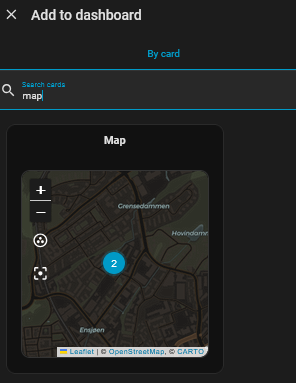
  1. Add the entity to a map card, which has the "hours to show"-attribute set, to display movement history
image

image

image

(The left arrow showing the custom setting, and the right arrow showing a data point which needs to be hovered)

  1. The payload executes when hovering a data-point (here shown with an "alert(document.domain"-payload)

image

Impact

The impact of this vulnerability is that a user can target other users of the system and perform account takeover through client side exploitation of XSS.

In the context of this system, I believe the vulnerability to be less impactful than the CVSS metric describes, as it requires a specific setup (map-card with attribute hours_to_show set, as this brings up the trail). It is interesting to note that any user who sets this attribute, will be highly likely to trigger the vulnerability through normal use. It also has no potential for being imported through seemingly innocent integrations and can only be set explicitly by another invited user, a device name, a cloud service or through social engineering. Other devices which has the same sensor can trigger the same vulnerability, and I expect there to exists cloud-based devices that would enable a threat actor to deliver the payload remotely.

Suggested criticality: Medium

Credit: Robin Lunde - https://robinlunde.com

References

@bramkragten bramkragten published to home-assistant/core Mar 27, 2026
Published by the National Vulnerability Database Mar 27, 2026
Published to the GitHub Advisory Database Mar 27, 2026
Reviewed Mar 27, 2026
Last updated Mar 27, 2026

Severity

Low

CVSS overall score

This score calculates overall vulnerability severity from 0 to 10 and is based on the Common Vulnerability Scoring System (CVSS).
/ 10

CVSS v4 base metrics

Exploitability Metrics
Attack Vector Network
Attack Complexity Low
Attack Requirements Present
Privileges Required Low
User interaction Active
Vulnerable System Impact Metrics
Confidentiality Low
Integrity Low
Availability None
Subsequent System Impact Metrics
Confidentiality None
Integrity None
Availability None

CVSS v4 base metrics

Exploitability Metrics
Attack Vector: This metric reflects the context by which vulnerability exploitation is possible. This metric value (and consequently the resulting severity) will be larger the more remote (logically, and physically) an attacker can be in order to exploit the vulnerable system. The assumption is that the number of potential attackers for a vulnerability that could be exploited from across a network is larger than the number of potential attackers that could exploit a vulnerability requiring physical access to a device, and therefore warrants a greater severity.
Attack Complexity: This metric captures measurable actions that must be taken by the attacker to actively evade or circumvent existing built-in security-enhancing conditions in order to obtain a working exploit. These are conditions whose primary purpose is to increase security and/or increase exploit engineering complexity. A vulnerability exploitable without a target-specific variable has a lower complexity than a vulnerability that would require non-trivial customization. This metric is meant to capture security mechanisms utilized by the vulnerable system.
Attack Requirements: This metric captures the prerequisite deployment and execution conditions or variables of the vulnerable system that enable the attack. These differ from security-enhancing techniques/technologies (ref Attack Complexity) as the primary purpose of these conditions is not to explicitly mitigate attacks, but rather, emerge naturally as a consequence of the deployment and execution of the vulnerable system.
Privileges Required: This metric describes the level of privileges an attacker must possess prior to successfully exploiting the vulnerability. The method by which the attacker obtains privileged credentials prior to the attack (e.g., free trial accounts), is outside the scope of this metric. Generally, self-service provisioned accounts do not constitute a privilege requirement if the attacker can grant themselves privileges as part of the attack.
User interaction: This metric captures the requirement for a human user, other than the attacker, to participate in the successful compromise of the vulnerable system. This metric determines whether the vulnerability can be exploited solely at the will of the attacker, or whether a separate user (or user-initiated process) must participate in some manner.
Vulnerable System Impact Metrics
Confidentiality: This metric measures the impact to the confidentiality of the information managed by the VULNERABLE SYSTEM due to a successfully exploited vulnerability. Confidentiality refers to limiting information access and disclosure to only authorized users, as well as preventing access by, or disclosure to, unauthorized ones.
Integrity: This metric measures the impact to integrity of a successfully exploited vulnerability. Integrity refers to the trustworthiness and veracity of information. Integrity of the VULNERABLE SYSTEM is impacted when an attacker makes unauthorized modification of system data. Integrity is also impacted when a system user can repudiate critical actions taken in the context of the system (e.g. due to insufficient logging).
Availability: This metric measures the impact to the availability of the VULNERABLE SYSTEM resulting from a successfully exploited vulnerability. While the Confidentiality and Integrity impact metrics apply to the loss of confidentiality or integrity of data (e.g., information, files) used by the system, this metric refers to the loss of availability of the impacted system itself, such as a networked service (e.g., web, database, email). Since availability refers to the accessibility of information resources, attacks that consume network bandwidth, processor cycles, or disk space all impact the availability of a system.
Subsequent System Impact Metrics
Confidentiality: This metric measures the impact to the confidentiality of the information managed by the SUBSEQUENT SYSTEM due to a successfully exploited vulnerability. Confidentiality refers to limiting information access and disclosure to only authorized users, as well as preventing access by, or disclosure to, unauthorized ones.
Integrity: This metric measures the impact to integrity of a successfully exploited vulnerability. Integrity refers to the trustworthiness and veracity of information. Integrity of the SUBSEQUENT SYSTEM is impacted when an attacker makes unauthorized modification of system data. Integrity is also impacted when a system user can repudiate critical actions taken in the context of the system (e.g. due to insufficient logging).
Availability: This metric measures the impact to the availability of the SUBSEQUENT SYSTEM resulting from a successfully exploited vulnerability. While the Confidentiality and Integrity impact metrics apply to the loss of confidentiality or integrity of data (e.g., information, files) used by the system, this metric refers to the loss of availability of the impacted system itself, such as a networked service (e.g., web, database, email). Since availability refers to the accessibility of information resources, attacks that consume network bandwidth, processor cycles, or disk space all impact the availability of a system.
CVSS:4.0/AV:N/AC:L/AT:P/PR:L/UI:A/VC:L/VI:L/VA:N/SC:N/SI:N/SA:N/E:P

EPSS score

Exploit Prediction Scoring System (EPSS)

This score estimates the probability of this vulnerability being exploited within the next 30 days. Data provided by FIRST.
(9th percentile)

Weaknesses

Improper Neutralization of Input During Web Page Generation ('Cross-site Scripting')

The product does not neutralize or incorrectly neutralizes user-controllable input before it is placed in output that is used as a web page that is served to other users. Learn more on MITRE.

Improper Neutralization of Script-Related HTML Tags in a Web Page (Basic XSS)

The product receives input from an upstream component, but it does not neutralize or incorrectly neutralizes special characters such as <, >, and & that could be interpreted as web-scripting elements when they are sent to a downstream component that processes web pages. Learn more on MITRE.

CVE ID

CVE-2026-33044

GHSA ID

GHSA-r584-6283-p7xc

Source code

Credits

Loading Checking history
See something to contribute? Suggest improvements for this vulnerability.