
Production-ready in 90 seconds. No headaches, just clean code.
GRAB is a Go boilerplate that doesn't waste your time — highly tested, Docker-ready, fully documented, AI-assistant optimized, with everything you need. Built for developers who want to code with AI, not fight it.







GRAB is designed to work seamlessly with your favorite AI coding assistants:





Out-of-the-box AI integration with comprehensive guidelines for:
- GitHub Copilot (VS Code, GoLand, Visual Studio)
- Cursor IDE (with dedicated
.cursor/rules/) - Windsurf IDE (with dedicated
.windsurf/rules/) - JetBrains AI (via AGENTS.md standard)
- Any AI assistant supporting AGENTS.md standard
Note: GoLand users get dual AI support through both GitHub Copilot (via
.github/copilot-instructions.md) and JetBrains AI (viaAGENTS.md). No IDE-specific configuration needed.
AI assistants understand GRAB's Clean Architecture, Docker-first workflow, migration patterns, and testing conventions. Get intelligent code completions, accurate refactoring suggestions, and context-aware help.
📚 Learn More: AI-Friendly Development Guide
You know the pain: Starting a new Go project means days of configuring Docker, wiring up authentication, setting up migrations, writing boilerplate code, and praying your hot-reload actually works.
GRAB changes that.
make quick-start # ← One command. 90 seconds. You're building features.This is the real deal. The production-grade boilerplate you wish you had from day one:
✅ Clean Architecture — Handler → Service → Repository (GO industry standard)
✅ AI-Optimized Guidelines — Built-in rules for GitHub Copilot, Cursor, Windsurf & AGENTS.md
✅ Security & JWT Auth — OAuth 2.0 BCP compliant with refresh token rotation, rate limiting, CORS
✅ Role-Based Access Control — Many-to-many RBAC with JWT integration and secure admin CLI
✅ Database Migrations — PostgreSQL with version control & rollback
✅ Comprehensive Tests — Unit + integration with CI/CD pipeline
✅ Interactive Docs — Auto-generated Swagger + Postman collection
✅ Structured Logging — JSON logs with request IDs and tracing
✅ Standardized API Responses — Consistent envelope format for all endpoints
✅ Structured Error Handling — Machine-readable error codes with details
✅ Production Docker — Multi-stage builds, health checks, optimized images
✅ Environment-Aware — Dev/staging/prod configs + Make automation & more
✅ Graceful Shutdown — Zero-downtime deployments with configurable timeouts
✅ Hot-Reload (2 seconds!) — Powered by Air, not magic
And that's just scratching the surface. Check the full documentation to see everything GRAB offers.
Not some random structure — follows official Go project layout + battle-tested community patterns from golang-standards/project-layout. The same architecture used by Gin, GORM, and production Go services.
- 🚀 Shipping Fast — Launch MVPs and production APIs in days, not weeks
- 👥 Team Projects — Consistent standards everyone understands
- 🏗️ Scaling Up — Architecture that grows with your business
- 📖 Learning Go — See how pros structure real-world applications
Get your API running in under 2 minutes:
- Docker and Docker Compose
- Git
💡 Want to run without Docker? See the Manual Setup Guide in the documentation.
git clone https://github.com/vahiiiid/go-rest-api-boilerplate.git
cd go-rest-api-boilerplate
make quick-start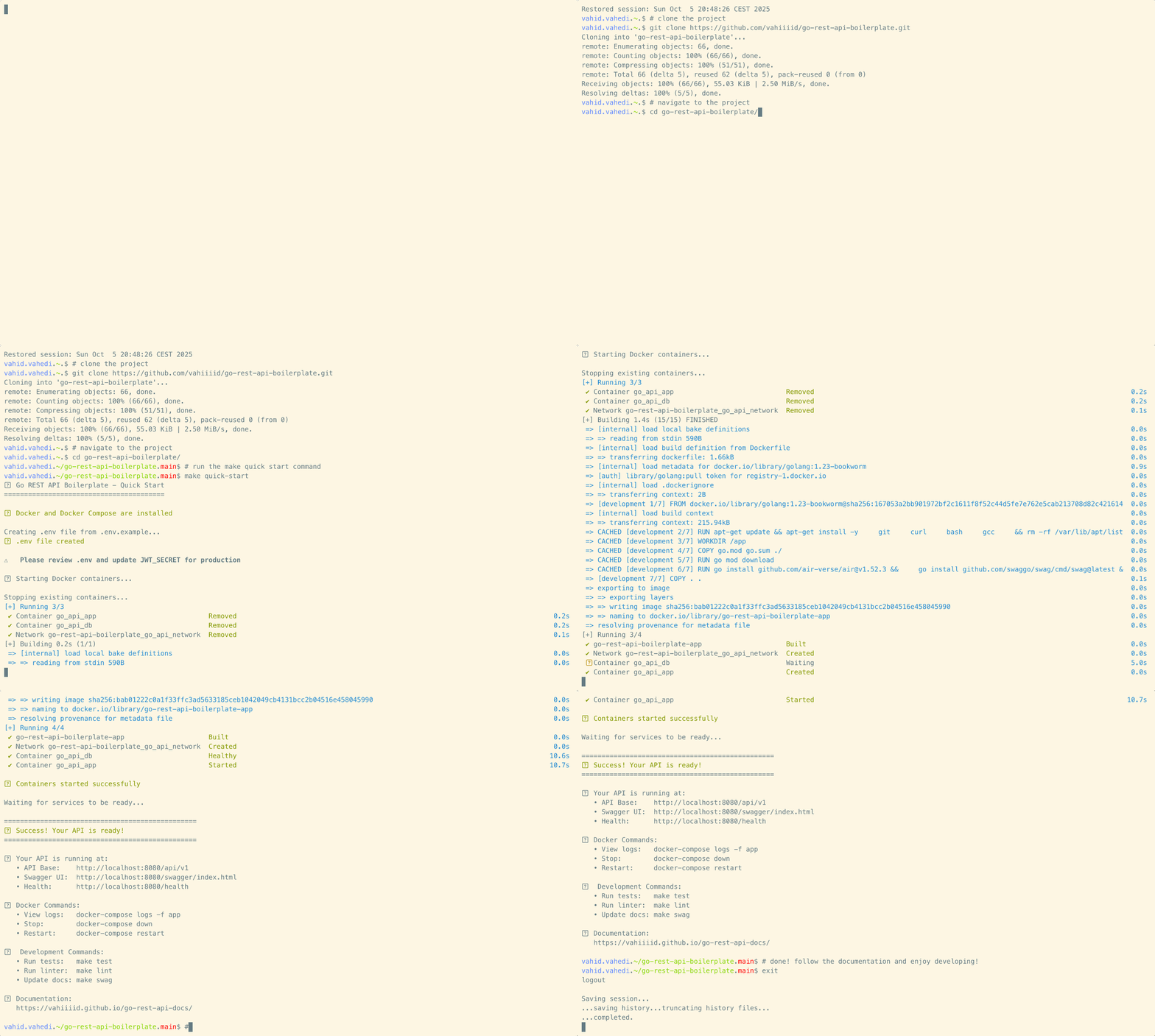
🎉 Done! Your API is now running at:
- API Base URL: http://localhost:8080/api/v1
- Swagger UI: http://localhost:8080/swagger/index.html
- Health Checks: http://localhost:8080/health • /health/live • /health/ready
Create Admin User:
make create-admin              # Interactive: prompts for email, name, password
make promote-admin ID=1        # Promote existing user to admin by ID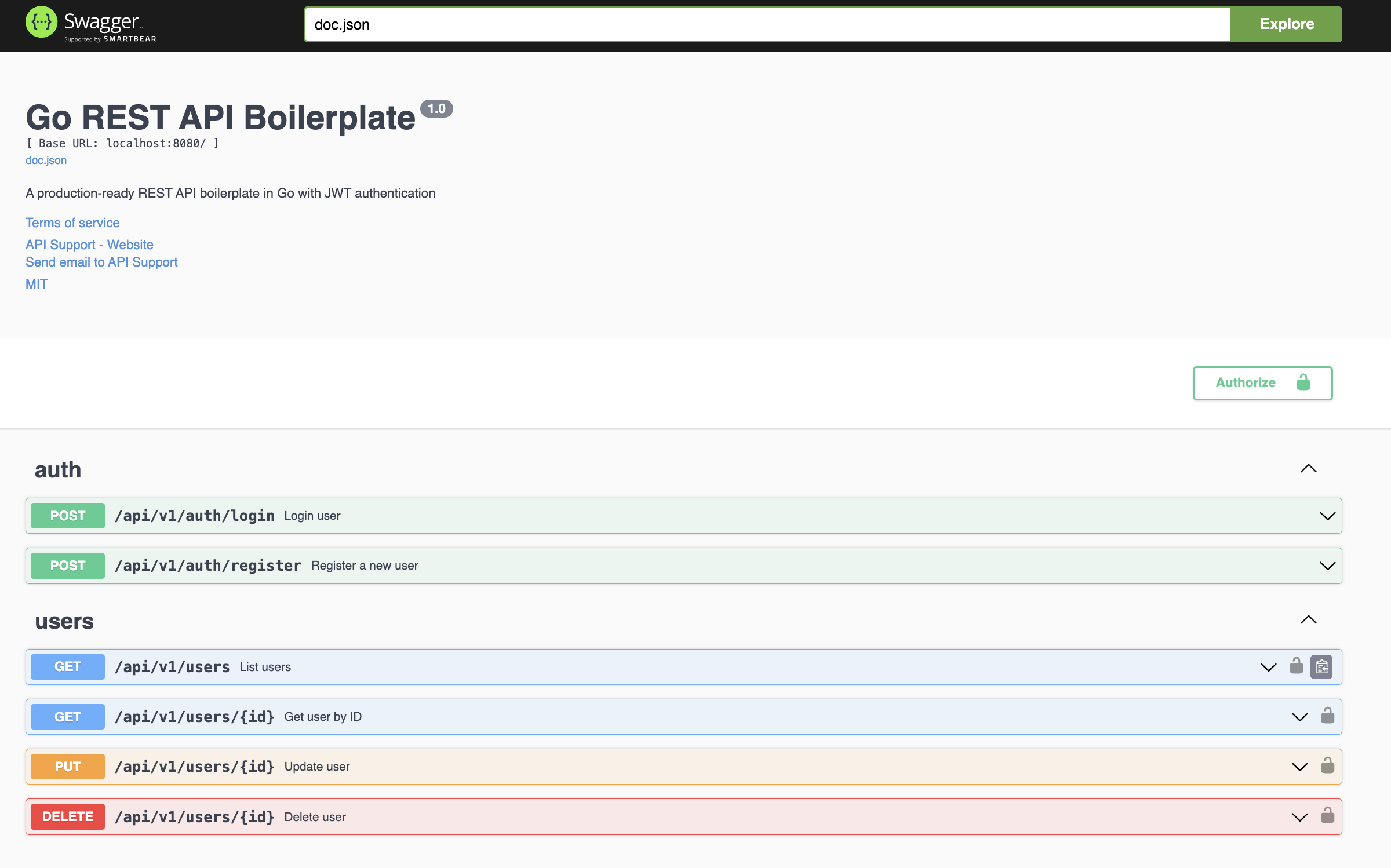
Open http://localhost:8080/swagger/index.html to explore and test all endpoints interactively.
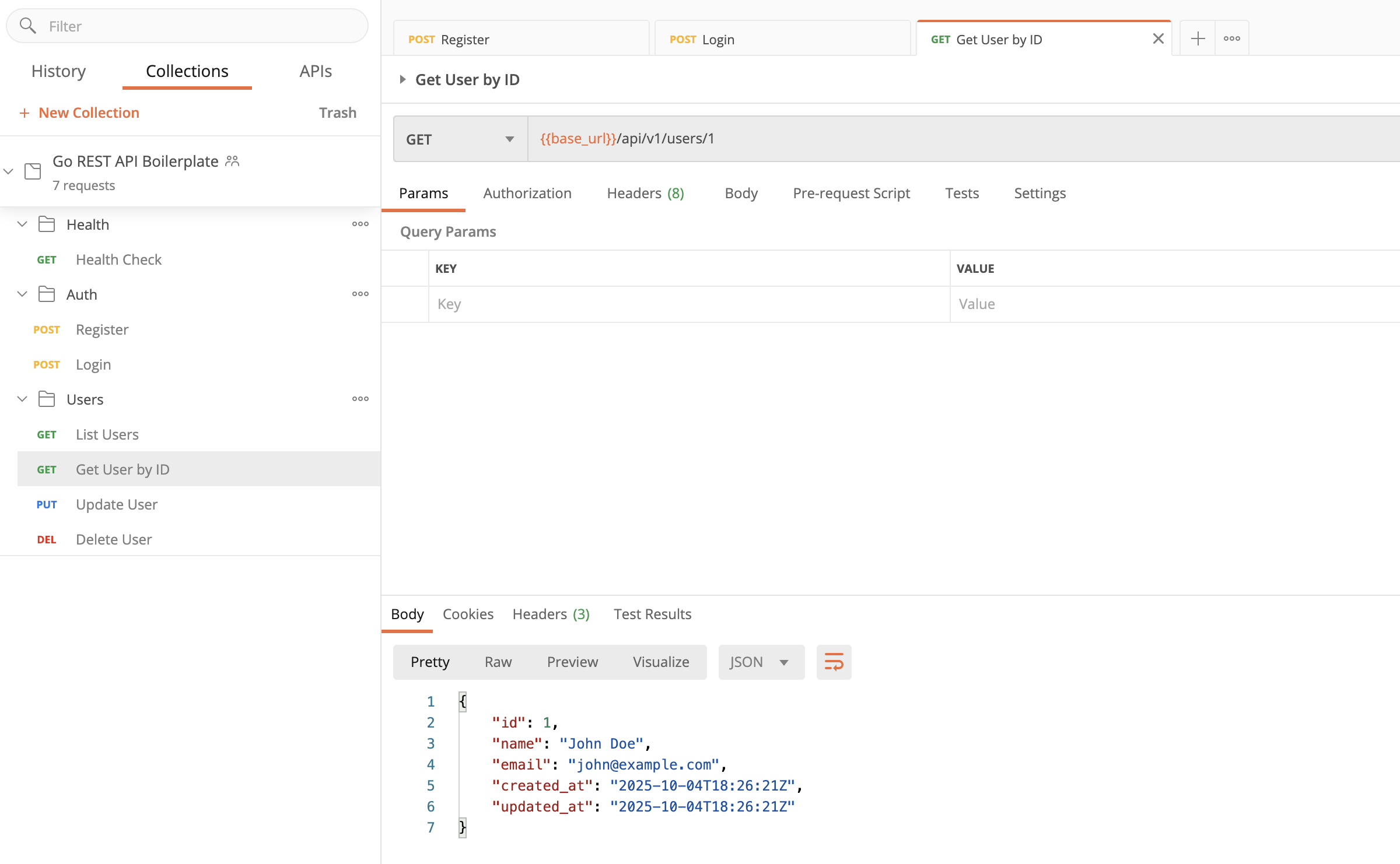
Import the pre-configured collection from api/postman_collection.json with example requests and tests.
🚀 Ready to Build?
- 📖 Development Guide — Learn how to add models, routes, and handlers
- 💡 TODO List Tutorial — Complete step-by-step feature implementation from scratch
Most boilerplates give you code. GRAB gives you a professional development workflow.
- OAuth 2.0 BCP compliant — JWT-based auth (HS256) with refresh token rotation and automatic reuse detection
- Enhanced security — Refresh tokens with family tracking, secure token invalidation, and breach detection
- Context helpers — Type-safe user extraction (no more casting nightmares)
- Password security — Bcrypt hashing with best-practice cost factor
- Rate limiting — Token-bucket protection against abuse built-in
👉 Authentication Guide | Context Helpers
- Many-to-many architecture — Flexible roles system with extensible permissions
- Secure admin CLI — Interactive admin creation with strong password enforcement (no defaults in code)
- JWT-integrated authorization — Roles embedded in tokens for server-side validation
- Protected endpoints — Middleware-based access control (RequireRole, RequireAdmin)
- Three-endpoint pattern —
/auth/me(current user),/users/:id(specific),/users(admin list) - Paginated user management — Admin-only user listing with filtering and search
-
PostgreSQL + GORM — Production-grade ORM with relationship support
-
golang-migrate — Industry-standard migrations with timestamp versioning
-
Complete migration CLI — Create, apply, rollback with ease
make migrate-create NAME=add_posts_table  # Create with timestamp
make migrate-up                            # Apply all pending
make migrate-down                          # Rollback last (safe)
make migrate-down STEPS=3                  # Rollback multiple
make migrate-status                        # Check current version
make migrate-goto VERSION=<timestamp>      # Jump to specific version
-
Safety features — Confirmation prompts, dirty state detection
-
Transaction support — BEGIN/COMMIT wrappers for data integrity
-
Connection pooling — Configured for performance out of the box
- 2-second hot-reload — Powered by Air, actually works in Docker
- One command to rule them all —
make quick-starthandles everything - Development & production — Separate optimized configs
- Multi-stage builds — Tiny production images (~20MB)
- Kubernetes-ready probes — Liveness (
/health/live) and readiness (/health/ready) endpoints - Database health monitoring — Response time tracking with pass/warn/fail thresholds
- RFC-compliant responses — Following IETF draft standards for health check format
- Zero-downtime deployments — Smart readiness checks for load balancer integration
- Extensible architecture — Easy to add custom health checkers (Redis, external APIs, etc.)
- Auto-generated Swagger — Interactive API explorer at
/swagger/index.html - Full documentation site — Not just README, real guides at vahiiiid.github.io/go-rest-api-docs
- Step-by-step tutorials — Build a TODO app from scratch
- Postman collection — Import and test immediately
- Comprehensive coverage — Handlers, services, and repositories all tested
- In-memory SQLite — No external dependencies for tests
- Table-driven tests — Go idiomatic testing patterns
- CI/CD ready — GitHub Actions configured and working
- Consistent envelope format — All responses wrapped in
{success, data, error, meta}structure - JSend-inspired design — Industry best practice for API response formatting
- Type-safe responses — Predictable structure for frontend integration
- Metadata support — Pagination, timestamps, request IDs built-in
- Structured API errors — Machine-readable codes (NOT_FOUND, VALIDATION_ERROR, etc.)
- Detailed error info — Code, message, details, timestamp, path, request ID
- Validation details — Clear field-level error messages for bad requests
- Centralized middleware — Single error handler for consistent responses
- Rate limit errors — Includes
retry_afterfor proper backoff logic
- Clean layers — Handler → Service → Repository (no shortcuts)
- Dependency injection — Proper DI, easy to mock and test
- Domain-driven — Organize by feature, not by layer
- Official Go layout — Follows golang-standards/project-layout
The easiest way to develop with hot-reload and zero setup:
make up        # Start containers with hot-reload
make logs      # View logs
make test      # Run all tests
make lint      # Check code quality
make lint-fix  # Auto-fix linting issues
make down      # Stop containers
What you get:
- 🔥 Hot-reload — Code changes reflect in ~2 seconds (powered by Air)
- 📦 Volume mounts — Edit code in your IDE, runs in container
- 🗄️ PostgreSQL — Database on internal Docker network
- 📚 All tools pre-installed — No Go installation needed on host
Production-grade migrations using golang-migrate:
make migrate-create NAME=add_todos_table  # Create new migration
make migrate-up                            # Apply all pending
make migrate-down                          # Rollback last migration
make migrate-status                        # Check current version
For long-running migrations:
go run cmd/migrate/main.go up --timeout=30m --lock-timeout=1mAll environments use SQL migrations for consistency and safety.
Want to run natively? You'll need Go 1.24+ installed.
make build-binary    # Build binary to bin/server
make run-binary      # Build and run (requires PostgreSQL on localhost)
👉 Full Setup Guide for native development
GRAB includes optimized production builds:
make docker-up-prod # Start production containersWhat's included:
- ✅ Multi-stage Docker builds (minimal image size)
- ✅ Production-grade health checks (liveness & readiness probes)
- ✅ Environment-based configuration
- ✅ No development dependencies
- ✅ Production logging
Ready for:
- AWS ECS/Fargate — Container orchestration
- Google Cloud Run — Serverless containers
- DigitalOcean App Platform — Platform-as-a-service
- Kubernetes — Self-managed orchestration
- Any VPS — Using Docker Compose
👉 Deployment Guide for step-by-step instructions
Complete guides covering everything:
- 🚀 Getting Started — Installation and configuration
- 💻 Development Guide — Building features
- 💡 TODO Tutorial — Step-by-step implementation
- 🐳 Docker Guide — Container workflows
- 🗄️ Migrations — Database schema management
- 🏥 Health Checks — Kubernetes probes and monitoring
- 🧪 Testing — Writing and running tests
- 📦 API Response Format — Standardized response envelope
⚠️ Error Handling — Structured API errors- 📚 Swagger — API documentation
- ⚙️ Configuration — Environment setup
Documentation lives in a separate repository. To contribute:
- Visit github.com/vahiiiid/go-rest-api-docs
- Follow the contributing guidelines
- Submit pull requests for improvements
For code contributions, see CONTRIBUTING.md
We ❤️ contributions! See CONTRIBUTING.md for:
- Code style guidelines
- Pull request process
- Testing requirements
- Commit conventions
- Fork the repository
- Create a feature branch (
git checkout -b feat/amazing-feature) - Make your changes
- Run tests and linter (
make lint-fix && make lint && make test) - Commit your changes (
git commit -m 'feat: add amazing feature') - Push to the branch (
git push origin feat/amazing-feature) - Open a Pull Request
- Gin — Fast HTTP web framework
- GORM — Developer-friendly ORM
- golang-migrate — Database migration toolkit
- Viper — Configuration management
- golang-jwt — JWT implementation
- swaggo — Swagger documentation generator
- Air — Hot-reload for development
This project is licensed under the MIT License - see the LICENSE file for details.
- 📖 Read the Documentation
- 🐛 Report Bugs
- 💬 Ask Questions
- ⭐ Star this repo if you find it helpful!
Made with ❤️ for the Go community
⭐ Star • 📖 Docs • 🐛 Issues • 💬 Discussions